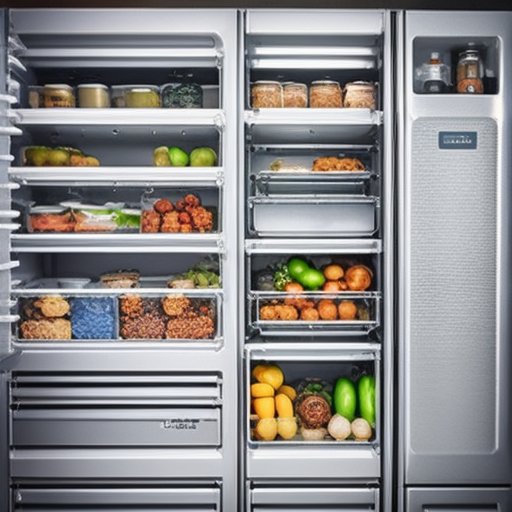
Introduction
The refrigerator is an essential part of our modern kitchens: it keeps our food fresh and safe to eat for far longer. Yet before it existed, preserving food was a constant challenge. This article traces the history of food preservation and the decisive role the refrigerator has played in that evolution.
Early Methods of Food Preservation
Long before mechanical cooling, humanity developed ingenious techniques to slow down food spoilage. Most of them worked by depriving micro-organisms of water, oxygen or favourable conditions:
- Drying, the oldest known method, removes the water bacteria need. Fish and meat were dried in the sun or wind.
- Smoking combines drying with antimicrobial compounds carried in the smoke.
- Salting draws water out of tissues through osmosis; salt was long a strategic commodity.
- Fermentation (sauerkraut, cheeses, yoghurts) uses beneficial micro-organisms to keep pathogens at bay.
- Sugar turned fruit into jams, while vinegar and oil protected vegetables.
Natural cold was used too: since antiquity, ice and snow were stored in underground ice houses, and by the 19th century a vast natural-ice trade supplied growing cities.
Nicolas Appert and the Birth of Canning
A major step came at the very start of the 19th century. The French confectioner Nicolas Appert, often called the "father of canning", devised a method of heating food inside hermetically sealed containers. He published his work in 1810, after more than a decade of experiments, in response to a prize offered by the French government to help feed its armies. Later reinforced by Louis Pasteur's discoveries about micro-organisms, this technique allowed food to be kept for months without any cold, transforming diets, trade and long-distance expeditions.
The Invention of Mechanical Refrigeration
The idea of artificial cooling took shape in the 18th and early 19th centuries. In 1805 the American inventor Oliver Evans described a cooling machine but never built it. It was Jacob Perkins who, in 1834, filed in London the first patent for a practical vapour-compression system able to produce ice continuously. Contrary to a common belief, this was not a domestic refrigerator but a laboratory apparatus, the direct ancestor of the refrigeration cycle we use today.
Mechanical cold then advanced quickly. In 1859 the Frenchman Ferdinand Carré developed an ammonia absorption machine, and from the 1870s the German engineer Carl von Linde refined industrial refrigeration, opening the way to large-scale preservation in breweries and the meat industry.
From the Laboratory to the Kitchen
It was only in the 20th century that the refrigerator truly entered homes. The first domestic electric unit, the DOMELRE, appeared in the United States in 1913. But it was the General Electric Monitor-Top, launched in 1927, that became the first great commercial success and made the appliance mainstream. For a full picture of this evolution, see our article on who invented the refrigerator and the different types of refrigerators that have appeared since.
Freezing and the Cold Chain
In parallel, mastering deep cold gave rise to the frozen-food industry. In the 1920s the American Clarence Birdseye developed a quick-freezing process inspired by Arctic ice fishing: freezing fast forms small ice crystals that better preserve a food's texture. This is the same principle used in our freezers today, and it explains why some foods keep their quality after thawing. Combined with refrigerated lorries and warehouses, this know-how created the "cold chain", which keeps a controlled temperature from producer to consumer.
The Refrigerator's Impact on Our Diet
The spread of the refrigerator profoundly changed the way we eat. We can now keep dairy, meat, fruit and vegetables far longer, cut down on waste and enjoy a varied diet all year round, even with food from distant regions. Cold slows bacterial growth, provided the right temperatures are respected: keeping the fridge at around 4 to 5°C remains the key to food safety, as we explain in our guide on how long a fridge takes to reach its ideal temperature.
Conclusion
From salting to canning, from the first vapour-compression machine to the global cold chain, food preservation tells the long story of a race against time and bacteria. The refrigerator is its most everyday achievement: opening its door, we touch two centuries of innovation that reshaped our kitchens, our health and our relationship with food.
Sources: Britannica - Nicolas Appert, ASME - The Perkins Vapor-Compression Cycle.