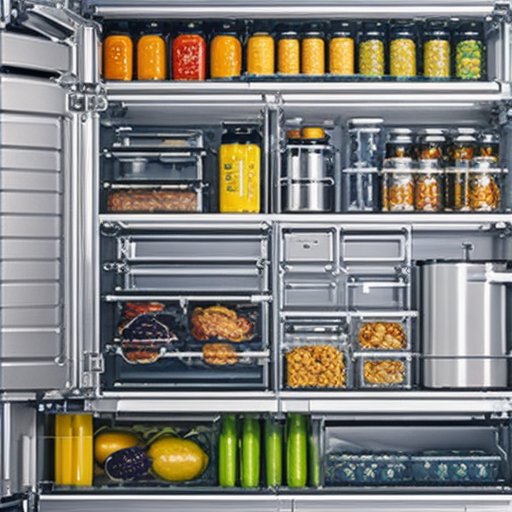
Your refrigerator is more than just a box that keeps your food cool. It's a complex system with many different parts, each having a specific function. In this article, we will explore the different parts of your refrigerator, from the storage compartments to the components that actually produce the cold, and discover their role in how this essential appliance works.
Refrigeration Compartment
The refrigeration compartment is the most visible and most used part of the refrigerator. This is where you store most of your food. The temperature in this compartment is maintained just above the freezing point to slow bacterial growth and extend the shelf life of food. It is not uniform, however: each zone has its own ideal temperature.
Freezer Compartment
The freezer compartment maintains a temperature well below the freezing point, allowing food to be preserved for long periods. It is ideal for storing meat, fish, frozen vegetables, and other foods you do not intend to use immediately.
Shelves and Bins
The shelves and bins in the refrigerator allow you to organize your food efficiently. Many modern refrigerators have adjustable shelves to accommodate items of different sizes.
Humidity-Controlled Drawers
These drawers are designed to maintain an optimal humidity level for certain foods. For example, they are ideal for storing fruits and vegetables that require a more humid environment to stay fresh.
Doors
The refrigerator door usually contains additional shelves for storage. It's a good place to store drinks, condiments, and other items you use frequently.
The Door Seal
The magnetic gasket that runs along the door keeps the refrigerator airtight. When it is supple and clean, it stops warm air from getting in and cold air from escaping, which limits frost build-up and electricity use. When it hardens or cracks, the motor runs more often, and it becomes worth replacing the door seal.
The Components That Produce the Cold
Behind the walls and at the back of the appliance lies the real engine of the cold. Most domestic refrigerators rely on the vapour-compression cycle, made up of four key components (MIT, How a Compression Refrigeration System Works; Danfoss).
- The compressor: this is the pump of the system, usually located at the bottom rear. It compresses the gaseous refrigerant, raising its pressure and temperature. It is what produces the appliance's faint humming.
- The condenser: this coil, most often fixed to the back of the refrigerator, releases into the room the heat drawn from inside. The refrigerant cools there and turns back into a liquid. Dust-covered coils make the appliance overheat and increase consumption.
- The expansion device or capillary tube: this very narrow passage causes a sharp drop in the refrigerant's pressure, which cools it strongly before it enters the evaporator.
- The evaporator: hidden behind the inner wall (often that of the freezer), this coil is the coldest part. The refrigerant absorbs heat from the food there and evaporates, then returns to the compressor to start the cycle again.
A refrigerant circulates in a closed loop through these components. Modern refrigerators most often use isobutane (R600a), a hydrocarbon with a very low climate impact that has replaced older gases. A thermostat or electronic sensor measures the internal temperature and controls the compressor to keep it stable.
The Defrost System
Moisture in the air turns to frost on the evaporator. No Frost appliances periodically heat the evaporator and drain the meltwater through a small outlet to a tray near the compressor, where it evaporates. On a conventional model, you need to defrost regularly to keep it efficient.
Conclusion
Each part of your refrigerator has a specific function designed to help you store your food efficiently and keep it longer. By understanding how each part works, you can make the most of your refrigerator and keep your food fresh and delicious. It also helps you choose better among the different types of refrigerators.
Join us next week for a new article on Refrigerator.ch, where we keep ideas fresh for a cooler everyday life!