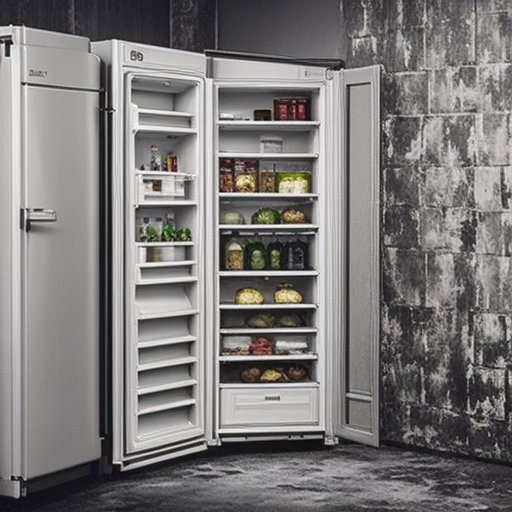
Introduction
The refrigerator is an essential part of our modern kitchens, but it has not always been this way. Join us on a journey through time to discover the fascinating history of the refrigerator, from natural ice to machines that produce cold on their own.
The Origins of Refrigeration
Preserving food with cold is very old. Long before electricity, people stored food in caves, underground cellars and icehouses packed with ice harvested in winter. In the 19th century, a genuine ice trade shipped blocks cut from frozen lakes into towns and cities.
The move from natural ice to mechanically produced cold happened in stages. In 1834, the engineer Jacob Perkins filed the first patent describing a vapour-compression refrigeration cycle, the very principle still used in our refrigerators today. Shortly after, physician John Gorrie, who was trying to cool his fever patients in Florida, was granted US patent No. 8080 in 1851 for a machine to make ice. This pioneering work laid the foundations of modern refrigeration, even though none of these devices was yet meant for the kitchen. To learn more about the people behind these breakthroughs, read our dedicated article on who invented the refrigerator.
The Industrial Era and Cold at Home
By the end of the 19th century, mechanical cooling spread first through industry. The German engineer Carl von Linde developed ammonia refrigerating machines that equipped breweries and slaughterhouses, turning cold production into a reliable large-scale technology.
Cold truly entered the home in 1913 with the DOMELRE (short for DOMestic ELectric REfrigerator). Designed by Fred W. Wolf Jr. in Chicago and sold from 1914, it was one of the very first ready-to-use, automatic electric refrigeration units, meant to sit on top of an existing icebox. Soon after, brands such as Kelvinator (1914) and then Frigidaire (1918) helped popularise the appliance, even though it remained expensive and bulky. The principle that drives these machines is explained in our article on how a refrigerator works.
The Modern Refrigerator
The real breakthrough came in the 1920s and 1930s. In 1927, General Electric launched the Monitor Top, nicknamed after its compressor mounted on top, which resembled the gun turret of the USS Monitor ironclad. Sold at roughly half the price of competing models and hermetically sealed, it became a huge commercial success and firmly established the electric refrigerator in ordinary households.
In the 1930s, new refrigerants known as CFCs and sold under the name Freon made appliances safer and more affordable, as they replaced the toxic or flammable gases used until then. Much later, those same refrigerants would be phased out for their impact on the ozone layer and the climate. This is also the era in which the different families of appliances covered in our look at future fridge technology began to take shape.
The Future of Refrigeration
Today, refrigerators are more sophisticated than ever, with digital controls, ice and water dispensers, touch screens and Wi-Fi connectivity. The underlying trend is twofold: cutting energy use and returning to natural refrigerants such as isobutane (R600a), which are far less harmful to the climate. Yet cold does not always require a machine, as our article on the desert fridge made from a clay pot reminds us.
Conclusion
The history of the refrigerator is a perfect example of how technology transforms daily life. From the icehouse packed with blocks of ice to the 1913 DOMELRE unit, then the Monitor Top and today's connected appliance, it has come a very long way. And this story, closely tied to the reasons why cold preserves food, is far from over.
Sources: John Gorrie and his 1851 patent (Smithsonian, National Museum of American History), Jacob Perkins and the vapour-compression cycle (ASME) and the DOMELRE, the first electric refrigerator (ASHRAE).